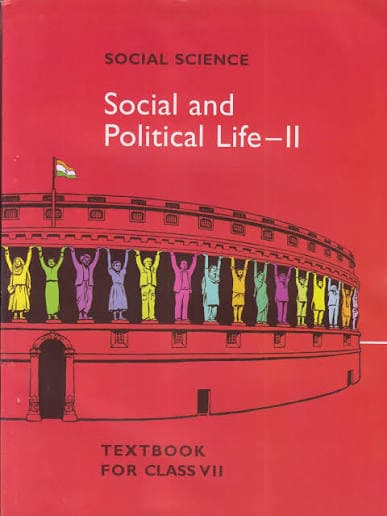
This is the National Council of Educational Research and Training (NCERT) social science civics textbook for Class VI, Social and Political Life I. It is an English medium (Roman script) book — the complete text, exercises, illustrations and captions are in English, and there is no Hindi content in it. It is the prescribed social and political life component of the Class 6 social science course for CBSE schools and for state boards that follow the NCERT curriculum.
The book introduces civics through the student's own surroundings rather than through constitutional abstraction. It begins with diversity — how differences of language, religion, region and custom exist within a single country and how inequality and discrimination differ from difference itself. It then asks what a government is, what it does, and why a democratic government is chosen through elections and answerable to the people. The chapters on local government take the student through the panchayati raj system at village level — the gram sabha, gram panchayat, and how a village's problems are raised and settled — and then to the work of the district administration, the police station and the patwari. The last section deals with rural and urban livelihoods, showing how people earn, what work is secure and what is not.
For a Class 6 student this is the school syllabus. For competitive-exam candidates the panchayati raj chapters are more useful than they look: the gram sabha, the panchayat samiti, the zila parishad and the working of the district administration are standing topics in the RPSC and RSSB syllabi and in the UPSC polity section, and the NCERT explanation of how these bodies actually function at ground level is clearer than most reference works manage. Aspirants are routinely advised to read the NCERT social and political life books from Class 6 onwards before starting on any standard polity text.
The chapters are supported by illustrations, photographs, case studies and short narrative accounts, with in-chapter questions and exercise sets at the end.
Key Features:
English medium book — complete content written in English (Roman script), no Hindi content
Published by NCERT (National Council of Educational Research and Training)
Social Science — Social and Political Life I, Textbook for Class VI (Class 6)
Prescribed for CBSE schools and state boards following the NCERT curriculum
Covers Understanding Diversity and Diversity and Discrimination
Covers What is Government and Key Elements of a Democratic Government
Covers Panchayati Raj — gram sabha, gram panchayat and village-level decision making
Covers Rural Administration — the police station, the patwari and land records
Covers Urban Administration — municipal corporation and municipality
Covers Rural Livelihoods and Urban Livelihoods
Civics introduced through everyday examples rather than abstract definitions
Illustrations, photographs, case studies and narrative accounts throughout
In-chapter questions and full chapter-end exercises
Base textbook for the CBSE Class 6 social science examination
Panchayati raj and local administration chapters useful for competitive examinations
Also widely used as foundation reading for UPSC, RPSC, RSSB and other competitive examinations
Standard NCERT text — the base book before any reference or guide
यह पुस्तक राष्ट्रीय शैक्षिक अनुसंधान और प्रशिक्षण परिषद (NCERT) द्वारा कक्षा VI (कक्षा 6) के लिए निर्धारित सामाजिक विज्ञान — सामाजिक एवं राजनीतिक जीवन की पाठ्यपुस्तक Social and Political Life I है। ध्यान दें: यह पुस्तक पूर्णतः अंग्रेज़ी भाषा एवं रोमन लिपि में है — इसमें हिन्दी भाषा का प्रयोग नहीं है। इसमें विविधता की समझ, विविधता एवं भेदभाव, सरकार क्या है, लोकतांत्रिक सरकार के प्रमुख तत्व, पंचायती राज (ग्राम सभा एवं ग्राम पंचायत), ग्रामीण प्रशासन (पुलिस थाना, पटवारी एवं भू-अभिलेख), नगर प्रशासन (नगर निगम एवं नगरपालिका) तथा ग्रामीण एवं शहरी आजीविका — ये अध्याय सम्मिलित हैं। चित्र, केस स्टडी तथा अध्यायांत अभ्यास प्रश्न दिए गए हैं। पंचायती राज एवं स्थानीय प्रशासन से जुड़े प्रश्न RPSC, RSSB एवं UPSC की परीक्षाओं में नियमित रूप से पूछे जाते हैं, और इनका आधार यहीं सरल रूप में स्पष्ट किया गया है।